

Buying a plot
What to Check Before Buying a Plot in Sweden – 15 Things to Investigate
Finding a beautiful plot at the right price is only the beginning. Two plots of similar size in the same municipality can have very different building possibilities — and very different costs.
Before buying land for a new home in Sweden, investigate what you can actually build, what lies beneath the surface, how the site can be accessed and connected, and what restrictions affect the property.
Have you found a plot?
Start investigating the plot in Bilby – it is completely free to use. Explore soil type, estimated soil depth and slope, then save the plot as a project to plan your build in our 3D site map and get a full cost estimate. Use the checklist to see what you need to investigate further.
Analyse soil, slope and ground conditions. Free to try, no account required.
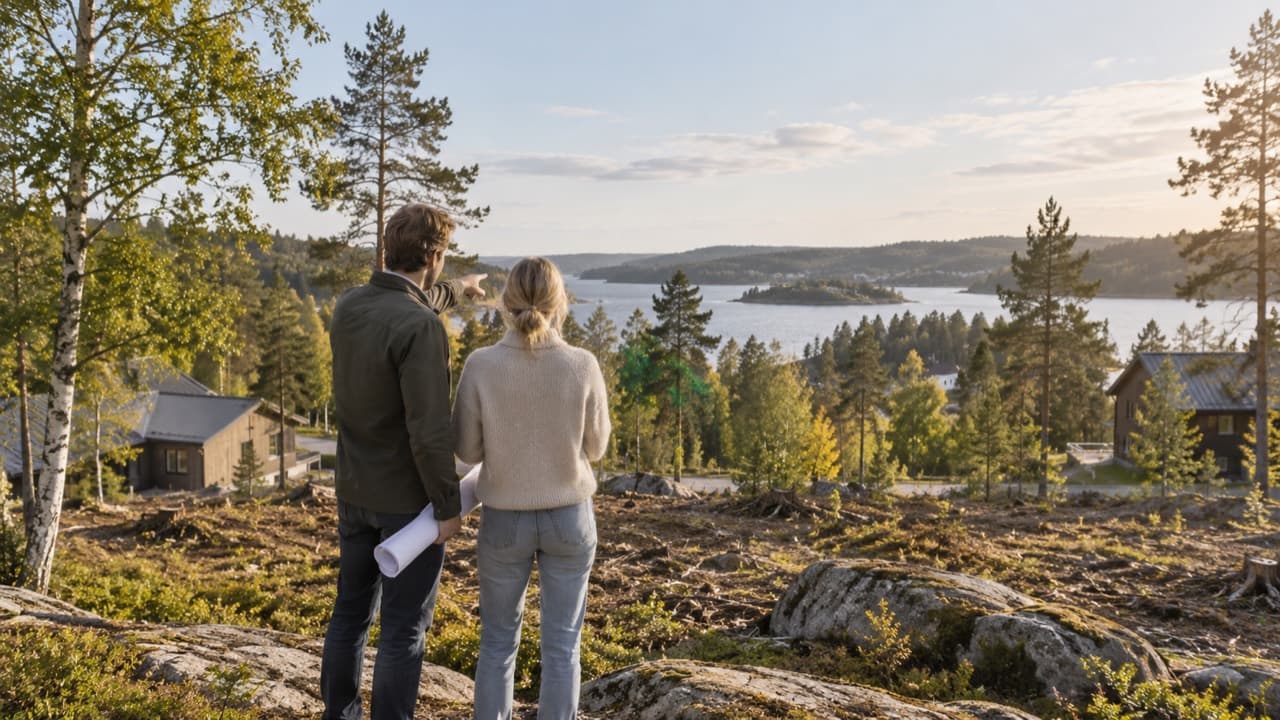
Here are 15 important things to check.
1. Can the plot actually be built on?
Never assume that an advertised building plot automatically means you can build the house you want.
First establish whether the property is covered by a detaljplan, områdesbestämmelser or other planning conditions.
For land outside a detailed plan, a förhandsbesked can be especially important. Boverket specifically warns that someone buying an undeveloped property without a positive preliminary decision risks owning land that cannot be developed as intended. Boverket
2. What does the detaljplan allow?
Where a detailed plan applies, investigate the actual building rights rather than simply checking that housing is permitted.
The plan may regulate matters such as the building’s footprint, placement, height, number of storeys, roof design and which parts of the plot may not be built on.
These restrictions can completely change which house models are suitable.
3. Check the property boundaries
Plot size alone does not tell you how usable the property is.
Look at its shape, dimensions and boundaries. A narrow or irregular plot can make house placement significantly more difficult.
Also remember that digital property boundaries should not be treated as legally exact. Lantmäteriet states that boundaries shown in its maps can vary considerably in positional accuracy and are not legally binding. Lantmäteriet
4. Check servitudes and other rights
A property may be affected by servitut, ledningsrätt or other rights.
For example, another property might have the right to use a road across the land, while your property might depend on access to a neighbour’s road or well.
Lantmäteriet records official servitudes and other property rights, although older records can sometimes be incomplete. Lantmäteriet
5. Check roads and access
How will construction vehicles — and eventually you — reach the house?
An existing road does not necessarily mean the property automatically has the right to use it.
Also investigate whether the road is public, private or part of a gemensamhetsanläggning. Properties participating in joint facilities can have responsibility for construction, operation and maintenance costs according to their share. Lantmäteriet
6. Understand the soil
Ground conditions can have a major impact on foundation design and groundwork.
Clay, silt, sand, moraine, peat and exposed bedrock behave very differently when building.
SGU publishes national soil maps that are useful for early-stage assessment, although SGU stresses that these maps are overview data and should be used cautiously for site-specific decisions. SGU
7. Check estimated soil depth
Knowing the surface soil type is not enough. You also want an indication of how deep it is before reaching bedrock.
Shallow rock could increase excavation or blasting requirements, while deep soft soils may lead to other foundation challenges.
SGU provides a national soil-depth model, but its uncertainty increases where measured observations are far away. SGU
8. Analyse the slope and elevation
A plot can look relatively flat during a viewing while still having enough elevation variation to affect construction.
Slope influences:
- excavation and filling
- retaining structures
- foundation design
- driveway gradients
- drainage
- garden construction
- house placement
A cheaper sloping plot can therefore become more expensive than a higher-priced flat plot once groundwork is included.
See the ground conditions and terrain for the plot you are considering.
9. Check ground stability
Certain soils and terrain combinations can increase the risk of settlement, landslides or other stability problems.
SGU provides early-stage mapping for ground stability and conditions associated with landslides. Importantly, SGU states that these tools do not replace site-specific investigations. SGU
If there are warning signs, professional geotechnical investigation becomes particularly important.
10. Investigate flooding and drainage
Consider where water will go during heavy rain and whether the property lies close to waterways, low points or known flood-risk areas.
Myndigheten för civilt försvar (formerly MSB) provides flood-risk mapping for Swedish waterways and coastal areas, while municipalities may have more detailed local information. Myndigheten för civilt försvar
Topography matters here too: water naturally collecting around the intended building area can lead to additional drainage and groundwork requirements.
11. Consider ground radon
Radon should also be considered when assessing a building site.
SGU states that radon from the ground is the most common source of radon in buildings and that uranium and radium occur to varying degrees in Swedish rock and soil. SGU
Potential radon conditions do not necessarily make a plot unsuitable, but they can affect how the building needs to be designed.
12. Check water and sewer connections
Find out whether the property can connect to municipal VA or requires private water and wastewater solutions.
Do not simply ask whether pipes exist nearby. Check:
- whether connection is available
- where the connection point is
- what the municipality charges
- whether additional excavation is required
- whether private solutions would need permits
Connection costs can become a substantial part of the project budget.
13. Check electricity and other infrastructure
Establish how electricity will reach the property and where the connection point is likely to be.
Long distances from existing infrastructure can increase costs.
It is also worth checking fibre or broadband availability if this matters to you, particularly for more rural plots.
14. Check strandskydd and other restrictions
A waterfront location can be attractive, but it can also introduce significant restrictions.
Within protected shoreline areas, construction and certain preparatory works can be prohibited unless an exemption or other applicable exception exists. Sweden’s shoreline-protection rules were amended in 2025, so current conditions should always be checked for the specific property. Naturvårdsverket
Other environmental, cultural or protected-area restrictions may also affect development.
15. Calculate the real cost of the plot
Finally, don’t evaluate a plot purely by its purchase price.
A 700,000 SEK plot requiring major excavation, difficult access and expensive utility connections could ultimately cost more than a 1,000,000 SEK plot with straightforward building conditions.
Consider the combined cost of:
Plot + groundwork + foundation + access + utility connections + permits and fees + landscaping
That is the number that matters when comparing building plots.
Analyse before you buy
Many of these questions traditionally require searching through separate maps, geological datasets, municipal pages and planning documents.
Bilby brings early-stage plot information together in one analysis, helping you understand factors such as terrain, slope, soil conditions, estimated soil depth, planning information and potential groundwork implications before committing to a property.
Bilby is intended as an early decision-making tool rather than a replacement for municipal decisions, legal property records or site-specific geotechnical investigations.
Found a plot you’re considering? Analyse it with Bilby before you buy.